Advertisement




Furlong (15')
Tries
Savea (18'), Williams (61'), Sititi (66'), Roigard (76')
Crowley (16')
Conversions
Barrett (19', 62', 66')
Crowley (6', 51')
Penalties
New Zealand's victory over Ireland in Chicago was their 3rd win in a row and 8th win in 10 so far in 2025 - a decent record by anyone's standards. However, the fragmented nature of the Ireland game did little to shake the feeling that Scott Robertson's All Blacks are labouring their way around the pitch. What's more, if we go past the eye test and deep dive the stats, we find evidence that they are indeed working too hard for their scores.
New Zealand pass the ball a lot. In their last 4 games they have a mean average of 199.5 passes per game. Contrast to the Springboks who passed the ball more than 150 times just twice during the rugby championship.
A high number of passes could be explained by a high proportion possession, which is something New Zealand have had in 7 of their 10 games this year, but even accounting for that they still pass the ball unusually frequently. If we look at passes per ruck, we see the All Blacks overaged 2.06 across The Rugby Championship (TRC) - 15% higher than any other team. They registered 2.18 passes per ruck against Ireland, the 6th time this year they have made at least 1.8.
That 1.8 cut-off is significant: Firstly, it is more than any other Southern Hemisphere team is averaging, and secondly, we see that during TRC, teams made 1.8 passes per ruck 12 times. On 9 of those 12 occasions, the team making that many passes lost - the only times they won being when the other side also made at least 1.8 passes per ruck.
Arguably, New Zealand's best performances this year came when they made the fewest passes per ruck: the 2nd test vs France (1.78) the 1st test vs Argentina (1.78) and the win at Eden park against the Springboks (1.67).
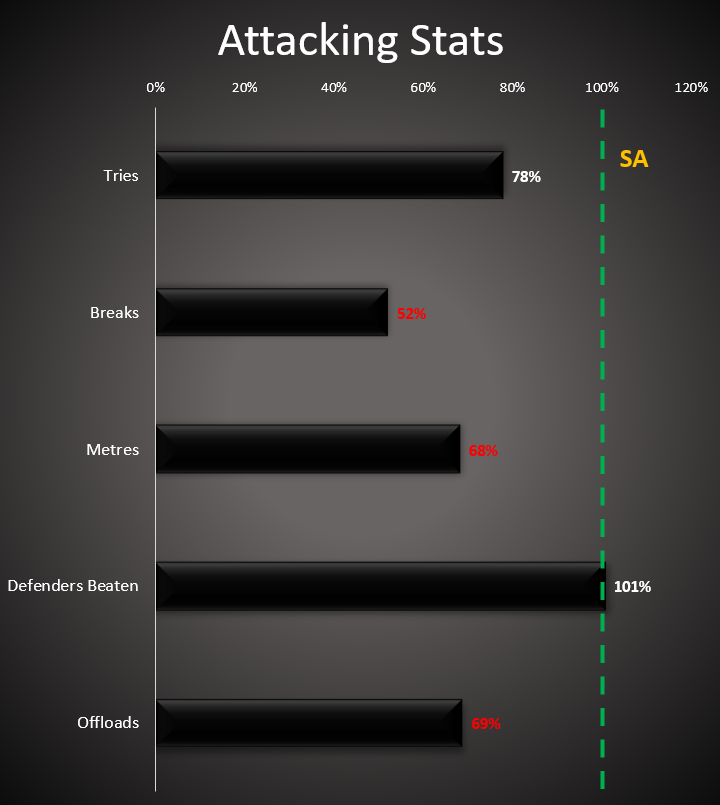
Another stat the All Blacks are registering highly in is defenders beaten, which sounds good until you realise that those beaten defenders aren't translating into either meters made or line breaks. The Springboks made 0.3 line breaks per defender beaten during TRC whilst the All Blacks made just 0.16 - nearly half. They also made nearly 900 meters fewer over the 6 games.
One could rationalise these numbers if the All Blacks were dominating territory, but they're not; In the first 4 rounds of TRC they average 41% territory and have had sub 50% territory in 6 of their last 10 games.
Their time in opposition 22 is also dropping. They average 31% of their ball in the opposition 22 in the first 5 games on 2025 only for it to drop to 21% in the most recent 5 games. In fact, if you remove the games against a very poor Australian team, New Zealand haven't had the better of any territorial battle since the 3rd test against France back in July.
This is likely influenced by the fact the All Blacks are reluctant to kick, usually putting boot to ball 25 times or fewer per games whereas South Africa are averaging 30. Their lineout has also deteriorated as the year has gone on with just a single 100% success game since the first round of TRC.
And yet when New Zealand do get to the opposition 22, they are quite good at scoring. Since the start of TRC they are averaging just 6.6 visits to the opponent 22 per game but are scoring 3.3 points per visit - which is very solid. For comparison, England averaged 1.6 points from their 13 visits against the Wallabies last weekend.
So whilst the All Blacks are still winning games and are still capable of scoring tries when they get the opportunities, it is fair to say they are making hard work of it and are frustrating to watch. They pass the ball remarkably frequently despite not having the territory and they aren't turning their possession into line breaks and meters gained at the rate that their rivals are.


